

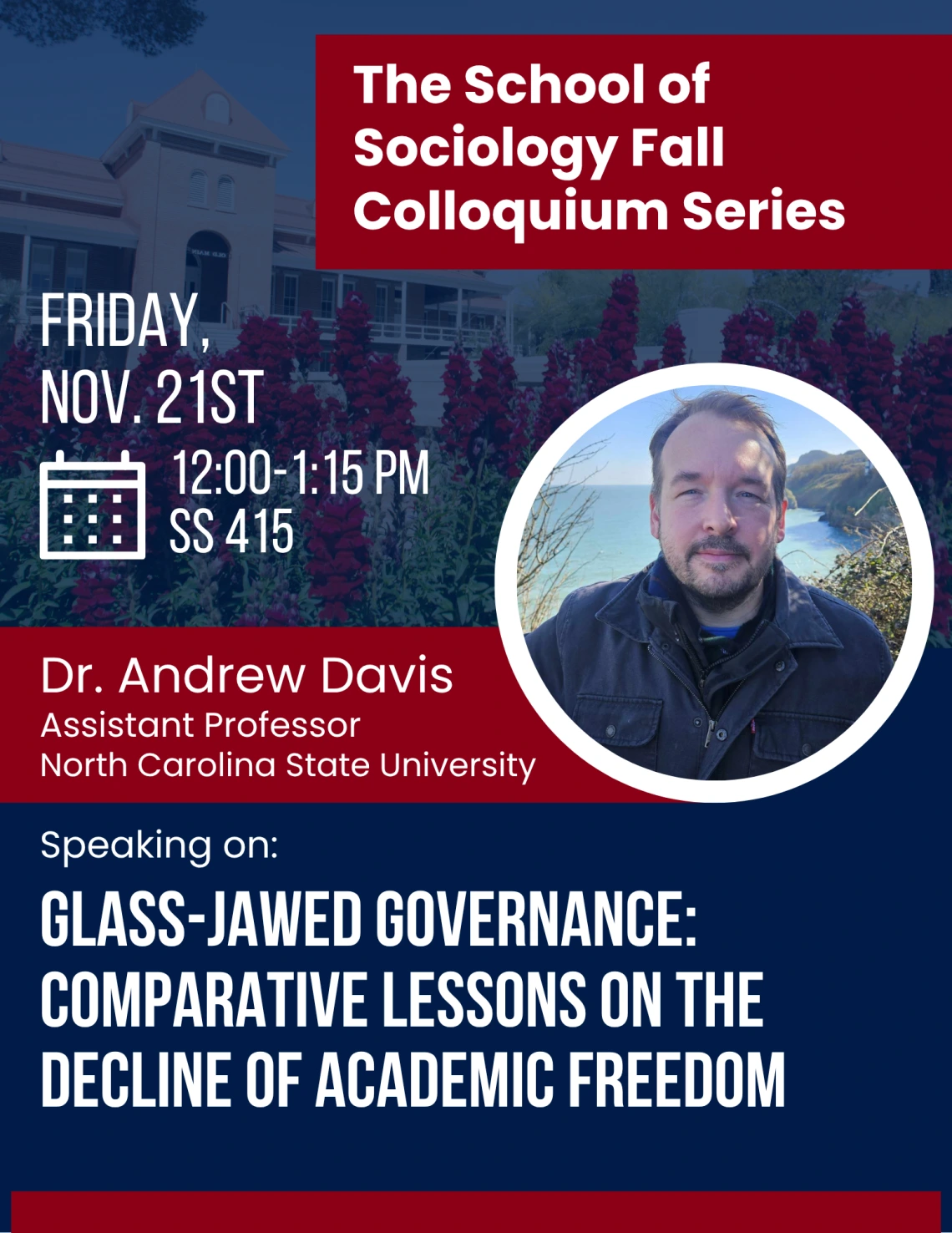
Dr. Andrew Davis - North Carolina State University
When
Where
This talk connects recent cross-national research on charismatic leadership and academic freedom to a broader analysis of the societal costs of academic decline. Charismatic authority depends on maintaining public belief in a leader’s exceptionalism, making independent critique from scholars and experts uniquely threatening. Such leaders often respond by censoring, co-opting, or criminalizing academic institutions—a pattern I term glass-jawed governance. Using comparative and historical data, I trace the downstream consequences of these attacks. As academic freedom erodes, the production of reliable knowledge deteriorates, innovation slows, faith in science declines for many. The effects extend beyond the university: societies that suppress academic autonomy experience weaker governance performance, poorer health outcomes, and reduced scientific and technological development. The analysis situates these findings within a sociological framework linking charisma, legitimacy, and the social foundations of credible knowledge.
Andrew Davis is an Assistant Professor of Sociology at North Carolina State University and an affiliated faculty member at the Duke Network Analysis Center. His research bridges global political sociology, criminology, and culture, examining how legitimacy, charisma, and expertise shape modern systems of power. Across projects on academic freedom, global governance, and punishment, his work explores how authority is constructed, challenged, and maintained across democratic and authoritarian contexts. His current book project analyzes the global decline of academic freedom and its broader consequences for knowledge production, innovation, and public trust. He received his PhD in 2019 at the University of Arizona's School of Sociology and is the current Co-Editor in Chief of Social Currents, the official journal of the Southern Sociological Society.